

Yeh Pulu is an ancient rock-cut architectural complex located near Ubud, close to the famous Goa Gajah (Elephant Cave). This unique monument of ancient Indonesian culture is an important historical and archaeological site in Bali.
The complex is situated in the village of Bedulu, which in ancient times was the capital of the Pejeng kingdom. Yeh Pulu dates back to the mid or late 14th century and is considered one of the most fascinating archaeological sites in Bali. It lies not far from Ubud, next to the well-known Goa Gajah cave.
Name and history
The word “Yeh” translates as “spring” or “water source,” while “Pulu” has two possible meanings: “stone rice” or “water vessel.” The complex was discovered thanks to an ancient spring that had existed here since time immemorial.
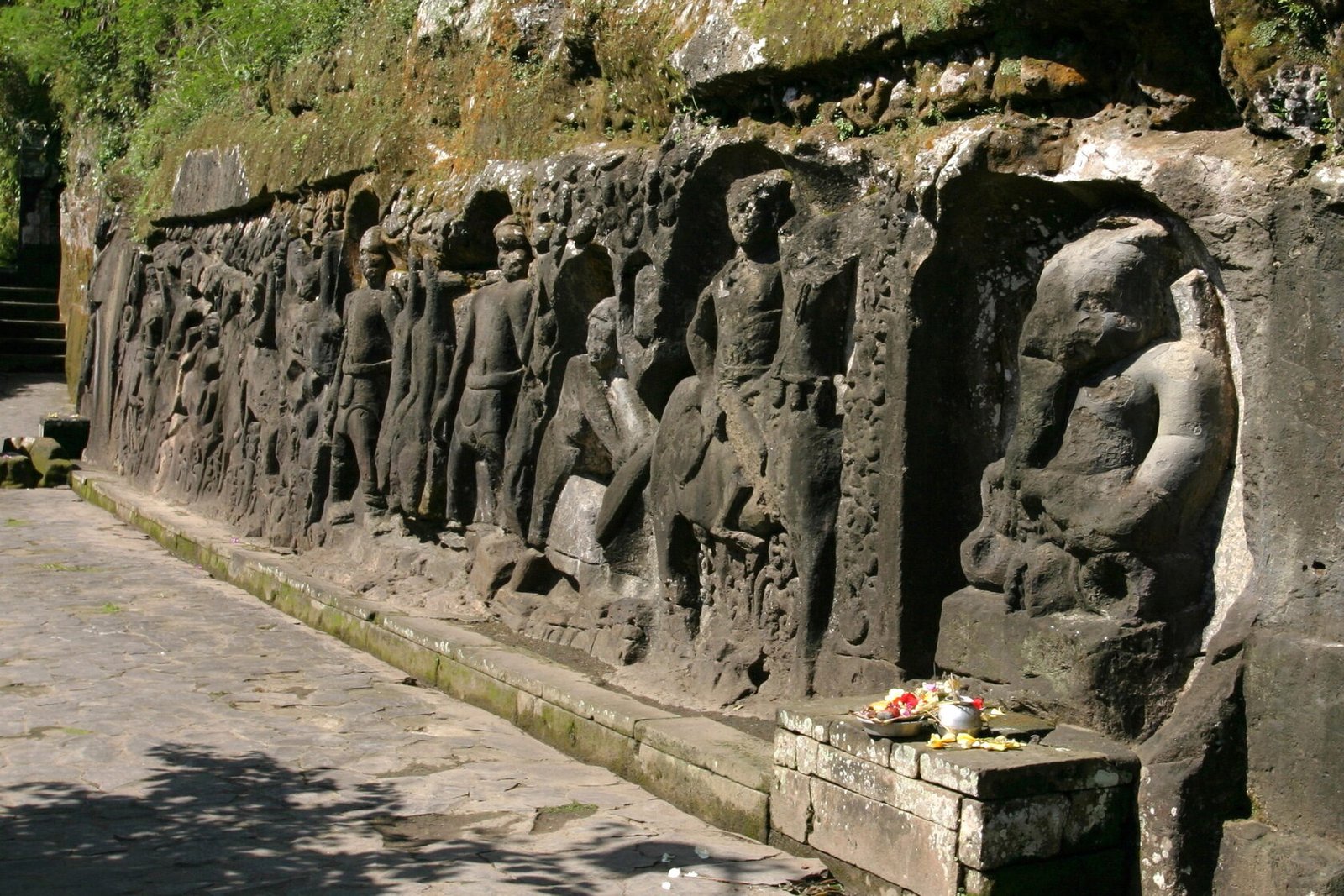
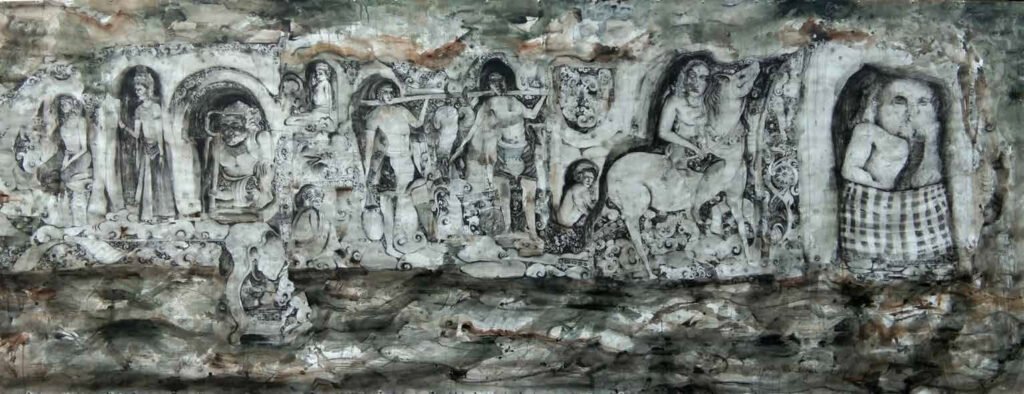
The site consists of two main elements: a 26.5-meter-long bas-relief carved into a limestone rock and a miniature temple. The bas-relief depicts scenes of everyday life and, according to researchers, was created by a single master, presumably a local artist.
Description of the bas-relief
The bas-relief begins with the figure of a stone youth greeting visitors with a raised hand. It then unfolds into five main scenes:
- First sceneA man is shown carrying containers on a pole, resembling a yoke. He is likely transporting water or palm wine. Nearby stands a woman of high status, richly dressed, possibly representing a priestess. Her figure is framed by a line, likely symbolizing a mandala. Another woman peers out from a doorway, as if inviting viewers to look into the past.
- Second sceneThis scene shows a seated woman conversing with a man carrying a hoe on his shoulder. Beneath her seat are carvings of small monkeys. Behind her stands another woman, listening to the conversation. A monk, seated slightly apart with a small altar in front of him, adds a sacred element to the depiction.
- Third sceneHere, hunters are shown attacking a wild boar with spears and blades, while a rider observes the hunt. In the upper right corner, two men sit facing each other, one handing the other a jug — a detail whose meaning remains uncertain.
- Fourth sceneMen carry the carcasses of hunted animals on a pole after a successful hunt. They are accompanied by a noble-looking horseman. Beside him is a woman holding the horse’s tail, but the rider ignores her gesture.
- Fifth sceneIn a niche of the rock stands the figure of Ganesha, the Hindu deity with the head of an elephant. In front of him is an offering altar. This place is considered sacred, and visitors are required to wear a sarong.
At the end of the bas-relief, there is a small shelter for the guardian of the site. This chamber is used for meditation and rest.
The miniature temple
Directly opposite the bas-relief is a small temple complex. It includes three grey-orange moss-covered pillars with carved patterns, decorated during festive occasions. The temple has traditional Balinese gates, and nearby stands a small house with a black thatched roof and orange walls. In the center is an offering table draped with poleng — the ritual black-and-white checkered cloth.
Visitor tips
- Wearing a sarong is mandatory (available for rent on-site).
- The best time to visit is in the morning or evening to avoid the heat.
- Take time to observe the details of the bas-relief and enjoy the tranquil atmosphere of this unique site.
Why visit Yeh Pulu
Yeh Pulu is not only an important historical site but also a place where visitors can feel the spirit of ancient Bali. The complex fascinates with its rock carvings that bridge the past and present. Surrounded by rice fields, the serene and harmonious atmosphere makes Yeh Pulu a must-visit destination.
History of discovery
When children told adults about their find, local villagers began clearing the spring. Under the sand, they discovered a stone basin into which the water flowed. The work continued until an ancient bas-relief adorned with mysterious carvings was revealed. Dutch archaeologists took part in the restoration of the site, and in 1949 they added a stone channel above the wall to divert rainwater and protect the bas-relief from damage. A significant contribution to the study of Yeh Pulu was made by Dutch professor August Johan Bernet Kempers, who described the complex in his book “Monumental Bali.”
Legends of Yeh Pulu
The complex is surrounded by many legends, each adding to its mystery.
The legend of Krishna
The figure of the young man with a raised hand at the entrance to the bas-relief is believed by some historians to depict the young Krishna. The raised hand symbolizes the moment when he was about to lift the sacred Govardhana mountain to protect farmers from the wrath of Indra, the god of rain. According to the legend, Krishna persuaded the people to stop worshipping Indra, which angered the deity and caused heavy rains. Krishna lifted the mountain like a giant umbrella, saving the people and their harvest. In the end, Indra admitted defeat, and Krishna became a symbol of power and protection.
The legend of the King of Bedulu
Another legend is connected with the king of the ancient kingdom of Bedulu. It is said that during meditation he could remove his head as a sign of reverence to the gods and then put it back. One day, however, his head slipped from his hands, fell into the river, and drifted away. To save their king, his subjects cut off the head of a passing boar and offered it in place of the lost one. Interestingly, a mysterious statue with a partially detached head still remains near the village. The name of the village, “Bedulu” (Beda Hulu), literally translates as “headless.”
Temple and monks’ cells
Near the spring are small temples and monks’ cells, which archaeologists believe were built in the 14th century. This site served as a retreat and place of prayer for ancient monks, who could meditate while drawing inspiration from the carvings on the bas-reliefs.
Yeh Pulu is located here