

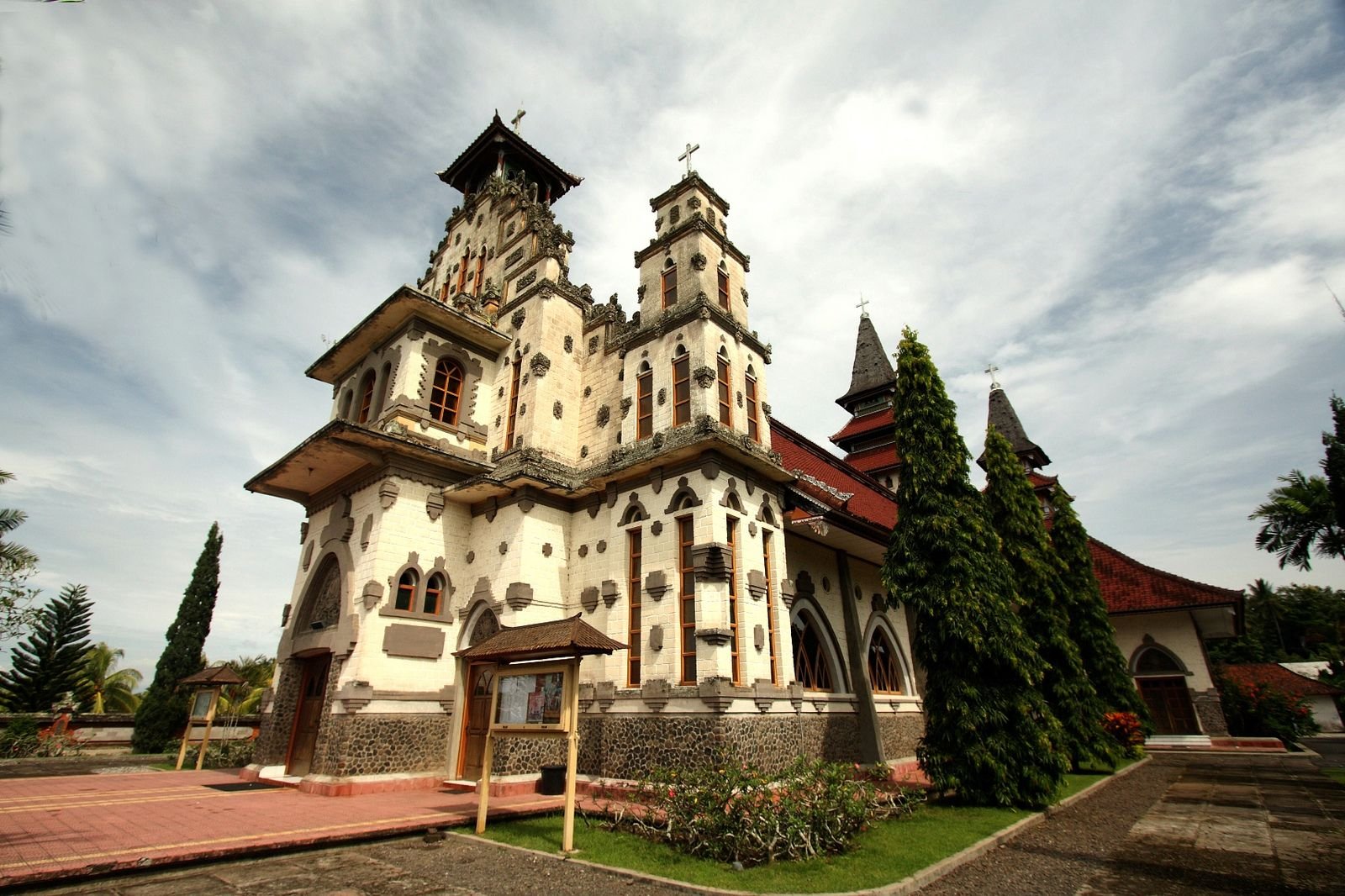
The Catholic Church in Palasari, known as the Church of the Sacred Heart of Jesus, was built in the mid-20th century and is located in the unique Christian village of Palasari in western Bali. It is one of the few places on the island where one can see a significant influence of Catholicism, which is otherwise rare in Bali.
Christianity in Bali has a long but complex history, shaped by colonization and resistance from local traditions. It remains a minority religion today: only about 2% of Bali’s population identify as Christians, compared to roughly 15% across Indonesia.
History of missionary activity in Bali
For a long time, Christianity was associated by the Balinese with foreign conquerors. Hinduism, deeply interwoven with the island’s social and cultural fabric, remained the spiritual foundation of the people, while Christianity failed to gain acceptance.
The first missionary to arrive in Bali was Anglican priest Reverend Ennis in 1838. However, his mission was unsuccessful, and he soon left the island. In 1865, the Dutch colonial government opened a Protestant mission in Singaraja. A year later, Reverend van Eck converted the first Balinese Christian, his servant Gusti Wayang Nurata Karangasem, who was baptized under the name Nicodemus. Yet, his conversion led to his expulsion from the community and ultimately to tragedy: in 1891, after the murder of Pastor de Vroom, Nicodemus was executed.
Following this, missionary activity was temporarily banned. It wasn’t until the 20th century that Christian preaching resumed, though with modest results. Balinese who embraced Christianity often faced exile, violence, and discrimination.
During the economic crisis of the 1930s, missionaries promised tax exemption for those who were baptized, leading to a temporary surge in conversions. However, when the deception was uncovered, many returned to Hinduism.
The current state of Christians in Bali
Today, most Christians on the island are locals, whereas in the early 20th century they were predominantly Europeans, Americans, or Chinese. Still, the situation for Christians in Indonesia remains challenging: the country ranks 46th in the world for levels of threat against Christians. Even in Bali, where attitudes are comparatively more tolerant, cases of intolerance continue to occur.
Many Christians face obstacles in registering congregations and establishing churches. Newly baptized believers may experience attacks and face pressure from relatives and neighbors.
Catholic and Protestant communities
Western Bali has become something of a melting pot, where migrants from across Indonesia and people of different cultures live side by side. This fosters a more tolerant environment toward people of different faiths. Catholic churches, Protestant communities, and even an Orthodox mission near Singaraja stand as examples of peaceful coexistence on the island.
Tolerance in Bali
Despite the challenges, Bali remains a place where attitudes toward followers of other religions are more welcoming than in many other parts of Indonesia. Christian migrants from elsewhere in the country often find refuge on the island, and the need to coexist on a limited territory helps foster mutual tolerance.
The Catholic community of Palasari village in Bali has a unique history that began in 1936. That year, Catholic priest Simon Buis, a member of the Verbi Societas Divini mission, arrived in the village of Tuka near Denpasar. His approach to missionary work was based on integration into the local culture. He learned Indonesian and Balinese, studied the traditions and way of life of the local people. Thanks to this, after just three years, almost all the residents of Tuka had become Christians. The Catholic community of this village still exists today.
At the same time, a Chinese Protestant mission began to operate in Bali. Their aggressive attitude toward Hinduism caused tension in society, which led to attacks on Christians. To reduce conflict, the government relocated the Protestants to the western part of the island, granting them land in the jungle.
Father Simon, concerned for the safety of his parishioners, asked the administration to allocate land for the relocation of the Catholic community. In 1940, they were granted 200 hectares of land in the western part of the island, near the Protestant village. On September 6, 1940, Father Simon, together with 24 parishioners, set out for their new settlement. The 120-kilometer journey, which they traveled on foot, became a true trial: only 18 people reached the destination.
On the new land, rich with nutmeg trees, the community built a small church. The village was named Palasari, which translates as “nutmeg” (“pala”) and “essence” (“sari”). During the Japanese occupation in 1942, Father Simon was arrested and sent to Sulawesi. Returning after the war in 1946, he found that the community had grown to 96 families.
With the proclamation of Indonesia’s independence, Father Simon secured official confirmation of the community’s land rights. He continued to serve until his death in 1960, and his memory lives on in Palasari — one of the village streets bears his name.
Between 1954 and 1958, a new Catholic church of the Sacred Heart of Jesus (Hati Kudus Yesus) was built on the site of the old dilapidated chapel. The project was led by Father Ignatius de Vrieze, while Balinese architects Ida Bagus Tugur and I Gusti Nyoman Rai brought his vision to life.
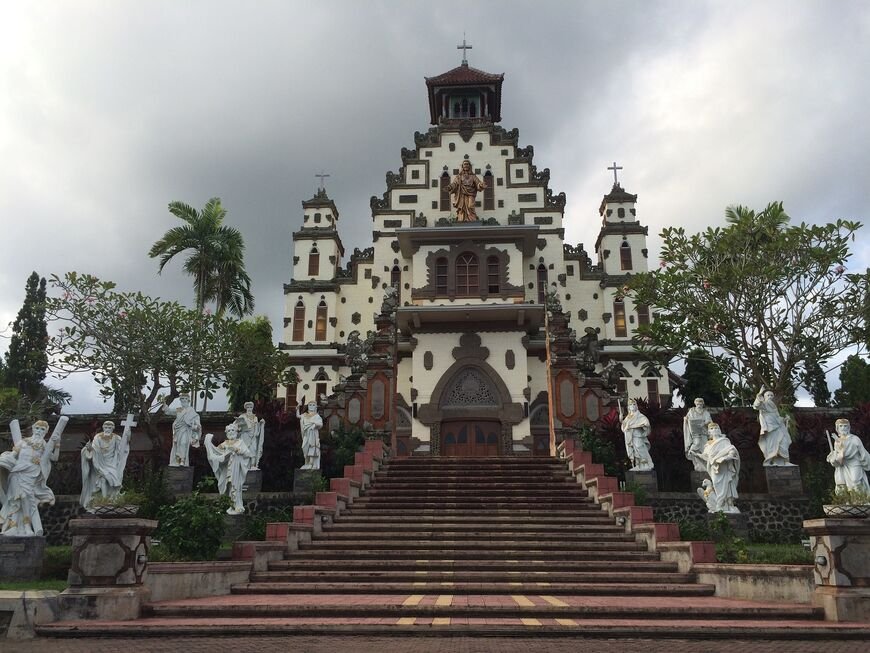
The new church is located in the center of the village and has the shape of a cross. Its architecture harmoniously combines Neo-Gothic style with traditional Balinese design. The project was created in accordance with the concept of the three mandalas, as in Hindu temples. The main gates, decorated with crosses, resemble the traditional Balinese candi bentar. The three domes of the church symbolize the Holy Trinity, and their shape recalls the meru towers typical of Hindu temples.
The black palm-fiber domes contrast strikingly with the white façade of the building. Seven crosses on the façade symbolize the Seven Sacraments of the Church. The church’s interior impresses with its vaulted ceiling supported by massive wooden beams. Spacious windows fill the space with soft natural light. Near the altar, statues of Mary and Jesus are flanked by umbrellas similar to those used in Hindu temples. Special attention is drawn to the figures of angels dressed in traditional Balinese costumes.
Today, Palasari village remains the largest Catholic community in Bali. In 2002, it was home to 319 families, and by 2006 the number had grown to 331. Despite migration programs that led some residents to move to Sulawesi and Sumatra, the community continues to grow and preserve its traditions.
The Church of the Sacred Heart of Jesus is not only a religious center but also a symbol of cultural synthesis, where Catholic faith has organically intertwined with Balinese traditions. Its unique architecture and historical significance make Palasari village an important landmark in Bali’s cultural heritage.
The Catholic Church in Palasari is located here