

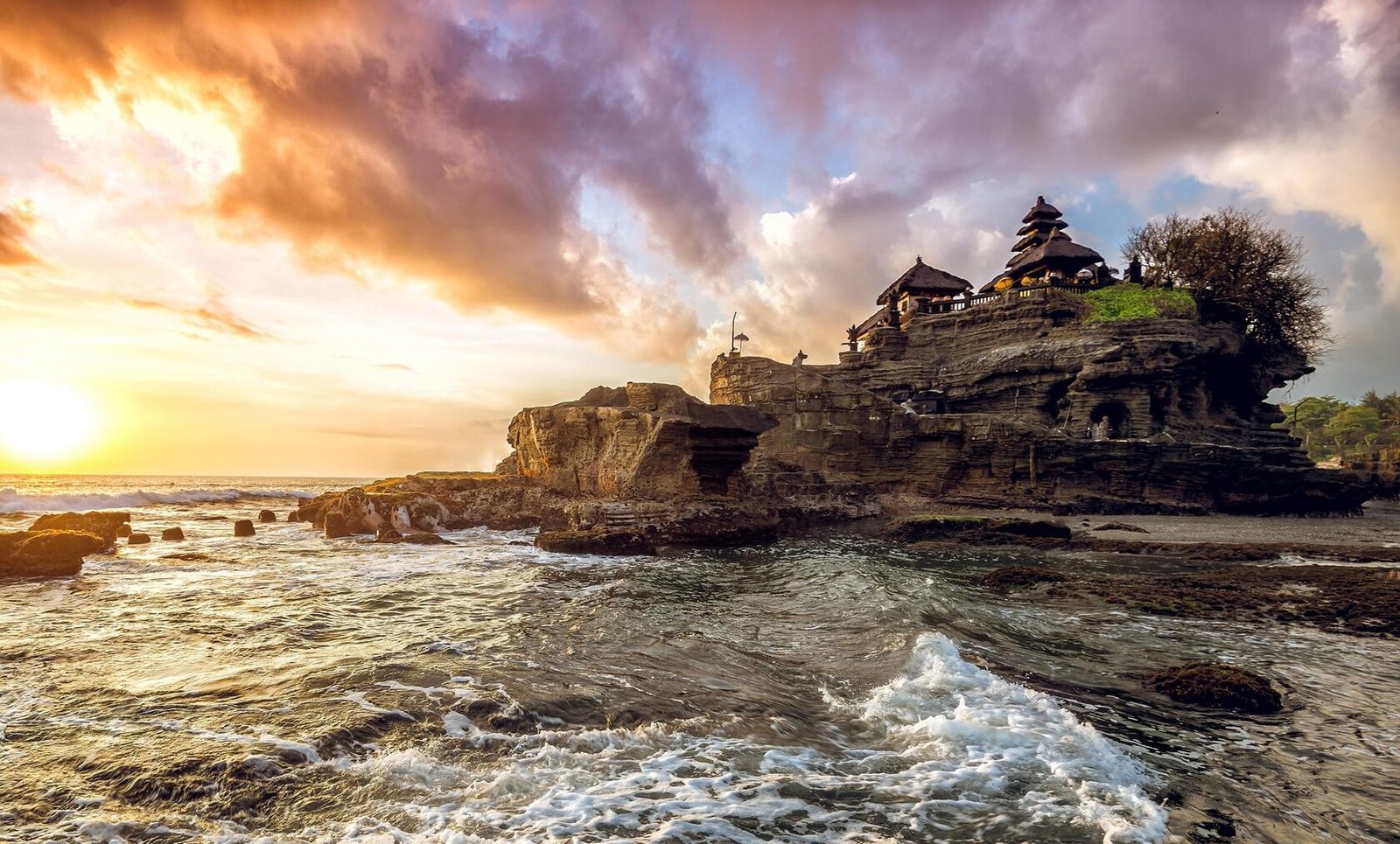
Pura Tanah Lot can be literally translated as follows: “Pura” means temple, “Tanah” means reef or island, and “Lot”means sea. This perfectly reflects the unusual location of this sanctuary.
Tanah Lot: the temple of ocean power and protection from evil spirits
Tanah Lot is one of Bali’s most famous temples, open to all visitors. However, the altars and ritual structures intended for religious ceremonies are accessible only to Hindu devotees and priests. Tourists can explore most of the temple grounds, enjoy the stunning views, and even dine at a restaurant overlooking the ocean.
A sea sanctuary with a protective function
Tanah Lot is one of the sea temples built along Bali’s southwest coast. A unique feature of these sanctuaries is that each temple was constructed within sight of the next, forming a spiritual chain of protection. According to Balinese belief, the ocean is home to demons and evil spirits, and the sea temples guard the island and its people from their influence.
Deities and saints worshiped at Tanah Lot
The temple is dedicated to sea gods, the most important of whom is Bhatara Segara, the embodiment of the ocean’s strength and power. A prominent element of the temple is its multi-tiered pagoda-like shrines, called meru. The number of tiers indicates which deity the shrine is dedicated to. For example, the five-tiered meru is dedicated to the sea god.
On the northern side of the temple, there is a smaller shrine dedicated to Dang Hyang Nirartha, a revered priest who played a major role in Balinese culture and whose life is surrounded by many legends.
Before entering the temple, worshippers perform a symbolic purification ritual: they pray and drink holy water from a sacred spring. Tourists are also welcome to take part in this ritual for a small donation, though access to the altars remains restricted.
Religious festivals
Daily ceremonies are held at Tanah Lot, but its most important festival, Piodalan, takes place once every 210 days according to the Balinese calendar. It begins five days before the temple’s anniversary and lasts for three days. During this time, thousands of pilgrims gather at the temple to pray for the island’s prosperity and for harmony between land and sea. The exact date of the festival changes, as the Balinese calendar has only 210 days.
Temple restoration
In 1980, Tanah Lot began to deteriorate: parts of the rock collapsed, and some areas within and around the temple became unsafe. At the time, Bali’s economy was struggling, and the local government lacked the funds for restoration. Assistance came from the Japanese government, which provided a $130 million loan to preserve Bali’s cultural heritage sites. Thanks to this, the temple was reinforced, and today more than one-third of the rock consists of carefully integrated artificial stone that blends seamlessly with the natural landscape.
A timeless symbol
Tanah Lot remains one of Bali’s most iconic landmarks, symbolizing the unity of spiritual and natural forces. The temple is especially breathtaking at sunset, when its silhouette glows in the warm golden light, creating an unforgettable atmosphere.

History of Tanah Lot Temple: The legacy of Nirartha
Tanah Lot Temple, one of the most revered temples in Bali, traces its origins back to the era of the great Brahmin Dang Hyang Nirartha, who arrived on the island in the late 15th century with a mission to strengthen Hinduism. At that time, Islam was spreading actively across Indonesia, and Nirartha devoted his life to establishing sacred places in Bali to preserve Hindu traditions.
A mystical place on the rock
During his journey across Bali, Nirartha once arrived near the village of Beraban, where he discovered an unusual rock resembling the shape of a bird. From the cracks of the rock flowed a spring that emitted a divine light. This sacred spot attracted the priest, and he began to pray and meditate there, addressing the god of the ocean. The spring, known as Tirta Pabersihan, still exists today. Its fresh water is considered healing, and anyone may drink it or take part in a purification ritual.
Conflict with the local leader
Legend says that Nirartha’s teachings inspired many villagers, who began to pray with him. However, this provoked anger from the local spiritual leader, Bendesa Beraban, who followed monotheistic beliefs. When the confrontation escalated into threats, Nirartha, using his spiritual power, is said to have moved the rock into the sea to protect himself and his followers. This miracle impressed Bendesa Beraban, who not only abandoned his hostility but also became Nirartha’s disciple.
Sacred snakes: myth or reality?
According to legend, Nirartha created venomous sea snakes to guard the temple against evil forces. Even today, coral snakes can be seen at the base of the rock, and locals consider them sacred. These snakes are usually passive, and incidents of bites are extremely rare. During low tide, tourists can, for a small donation, see one of these snakes in the caves near the rock.
Who built the temple?
There is no documentary evidence that Nirartha himself founded Tanah Lot Temple. Nevertheless, the priest’s contribution to strengthening Hinduism in Bali is acknowledged by both locals and historians. It is believed that fishermen built the sanctuary to pray for abundant catches. Scholars estimate that the temple is at least 500 years old.
Myths and reality
Although the legends and facts about Tanah Lot sometimes intertwine, this place remains a symbol of spiritual strength and Bali’s cultural heritage. Today, Tanah Lot is not only a place of worship but also one of the most visited attractions on the island, captivating visitors with its rich past and mystical atmosphere.
Tanah Lot Temple is located here