

Goa Gajah, also known as the Elephant Cave, is located near the town of Ubud in Bali. This ancient cultural and architectural monument is one of the island’s main attractions. Sometimes it is referred to as Goa Gajah Temple, although technically it is more of an archaeological and religious complex than a full-fledged temple.
Goa Gajah: an ancient temple complex in Bali
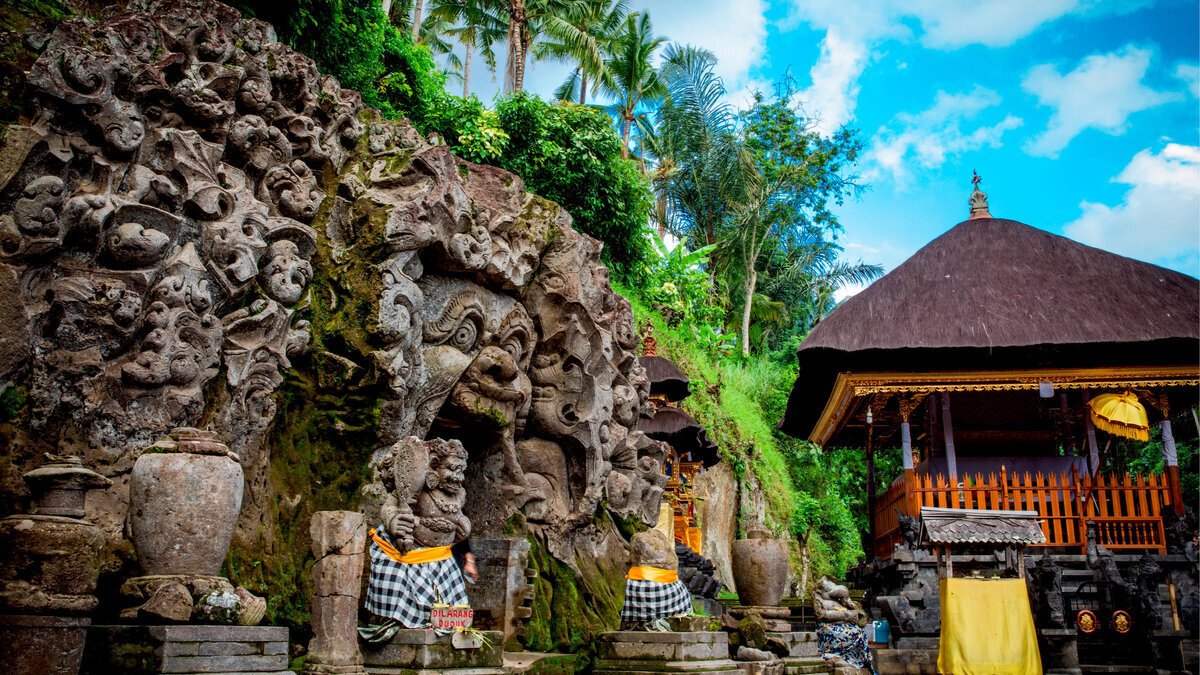
Goa Gajah, or the Elephant Cave, is nestled in dense jungle in a small depression. To enter the site, visitors must descend a staircase. The highlight of the complex is the famous Elephant Cave, the entrance of which is adorned with carved bas-reliefs.
Elephant Cave: architecture and symbolism
The cave façade is carved into rock and decorated with reliefs depicting a mythological creature that appears to frighten away people and animals. A closer look reveals ornaments in the form of forests, mountains, leaves, and waves. Over time, some parts have become covered with moss due to the humid climate, giving the cave an even more mysterious appearance.
Inside the cave are 15 niches carved into the walls. These niches were used for meditation, and locals still perform spiritual practices here today. To gain access to meditation, one must first undergo a purification ritual at the sacred bathing pool. The cave itself is small and shaped like the letter “T.” On the left is a statue of Ganesha, the Hindu god of wisdom and protector. On the right are three lingams, symbolizing the god Shiva. Locals believe that if a childless couple touches them, Shiva will bless the family with offspring. Other niches contain fragments of ancient statues, surrounded by offerings of flowers and fruit.
Other features of the complex
There are many fascinating structures within the complex.
To the left of the cave entrance stands a pavilion with three statues, one of which is Hariti. According to legend, she was once a giantess who devoured children, but after embracing Buddhism, she became their protector. The statue of Hariti is around 1,000 years old.
To the right of the cave lies the Pura Taman temple, home to a sacred spring dedicated to Vishnu, lord of the waters.
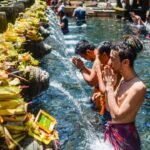
In front of the cave are two bathing pools, one for men and one for women, which were only discovered in 1954. Originally, water flowed into them from seven statues of maidens, representing the seven sacred rivers of India. Today, only six remain, while the seventh has been replaced with a lingam-yoni, symbolizing fertility.
Exploring the winding paths of the complex reveals even more remarkable sites. Among them is the Pura Petapan temple, which looks like a Hindu temple from the outside but contains a statue of Buddha inside the main pavilion.
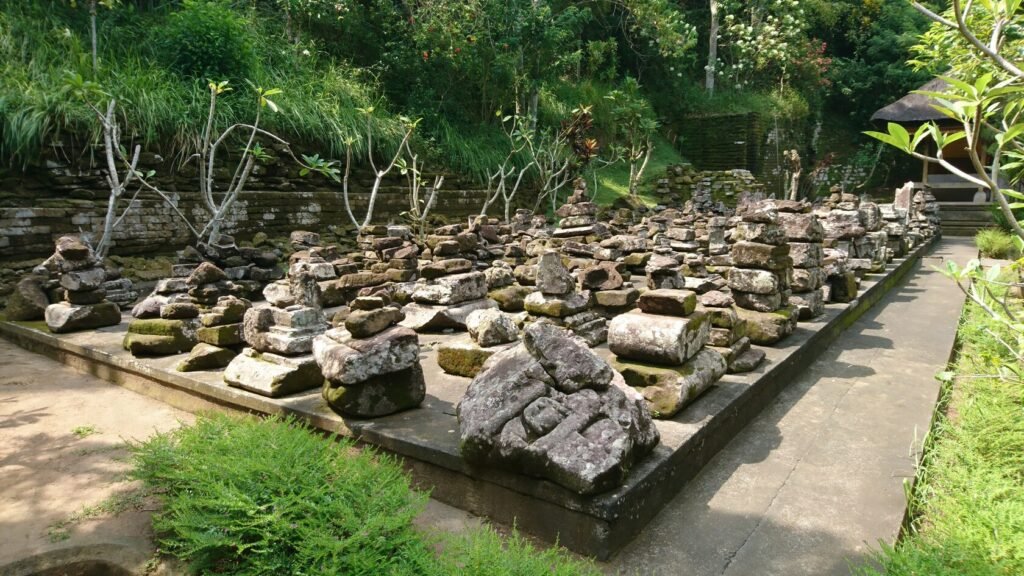
Within the park are a lily pond, sacred trees, small waterfalls, stone carvings, and the Pankung River with a bridge. Further along, visitors can explore the “Cave of Giants” (Goa Raksasa). Despite its name, the cave is not very large, with a ceiling suitable for an average person’s height and a depth of about 20 meters. Inside is a small statue, and the cave walls bear tool marks from ancient craftsmen.
Heading left from the Cave of Giants leads to a fork. One path descends along the Petanu River toward the Buddha Cave, while the other ascends to the Pura Dedari temple. Here visitors find a sacred spring and one of the oldest statues of Shiva in the region.
Why visit Goa Gajah
Goa Gajah is not only an important cultural and religious site but also a unique monument of Bali’s ancient art. Majestic bas-reliefs, mythological statues, and the harmony of nature make this place a must-visit. Here visitors can enjoy the tranquility of the jungle, the beauty of the surroundings, and connect with the island’s centuries-old history.
Goa Gajah, or the Elephant Cave, is one of the oldest monuments in Bali, dating back to the 9th–11th centuries. The exact time of its creation is still unknown, as is whether the cave is a natural hollow in the rock or a man-made construction by ancient craftsmen. Interestingly, the interior combines both Buddhist and Hindu elements, making it a unique site for study.
Origin and first mentions
It is believed that Goa Gajah belonged to the ancient Bali Aga people, who still live on the island today, for example, in the village of Trunyan. The first written reference to the cave dates back to 1365 in the Javanese work Nagarakretagama, written by the Majapahit court poet Prapanca. It mentions a Buddhist teacher who lived in the cave with his disciples, while the complex itself is described as one of the main Buddhist sites in Bali.
Europeans learned about the cave only in 1923, when it was discovered by Dutch colonizers. Until then, Goa Gajah had been carefully guarded by local residents. In the mid-20th century, archaeological excavations were carried out on the site, uncovering many Buddhist and Hindu statues. However, research went only about 10 meters deep, leading to the belief that many of the cave’s secrets remain undiscovered.
Legends about the cave entrance
The figure depicted at the entrance to Goa Gajah remains the subject of numerous theories and legends:
- The headless kingAccording to one version, the cave is located on the territory of the ancient kingdom of Bedulu (the modern name of a nearby village). The name translates as “headless.” Legend has it that a king skilled in meditation could temporarily detach his head from his body. One day, however, his head fell into the river. His subjects replaced it with the head of a pig, but the real head was carried downstream and washed ashore near Goa Gajah. It is said that this very head is depicted at the entrance.
- The forest spiritAnother version claims the entrance is adorned with the figure of a forest spirit protecting the sacred place.
- The devourer of evil thoughtsSome believe the bas-relief represents a mythological being that cleanses visitors of negative thoughts as they enter.
- Kebo IwaAccording to yet another legend, the entrance ornaments were carved with the finger of the mythical giant Kebo Iwa, a defender of Balinese lands.
- The elephant connectionThe name of the cave is also linked to the statue of Ganesha, the elephant-headed deity, found inside.
Origin of the name
The name “Goa Gajah” (Elephant Cave) is itself surrounded by speculation:
- Some suggest the cave was located between two rivers, one of which was called Lwa Gajah (Elephant River).
- Another theory claims that the first Europeans, upon seeing the bas-reliefs at the entrance, mistook them for elephant figures. They named the cave “Elephant,” and the locals later adopted this name.
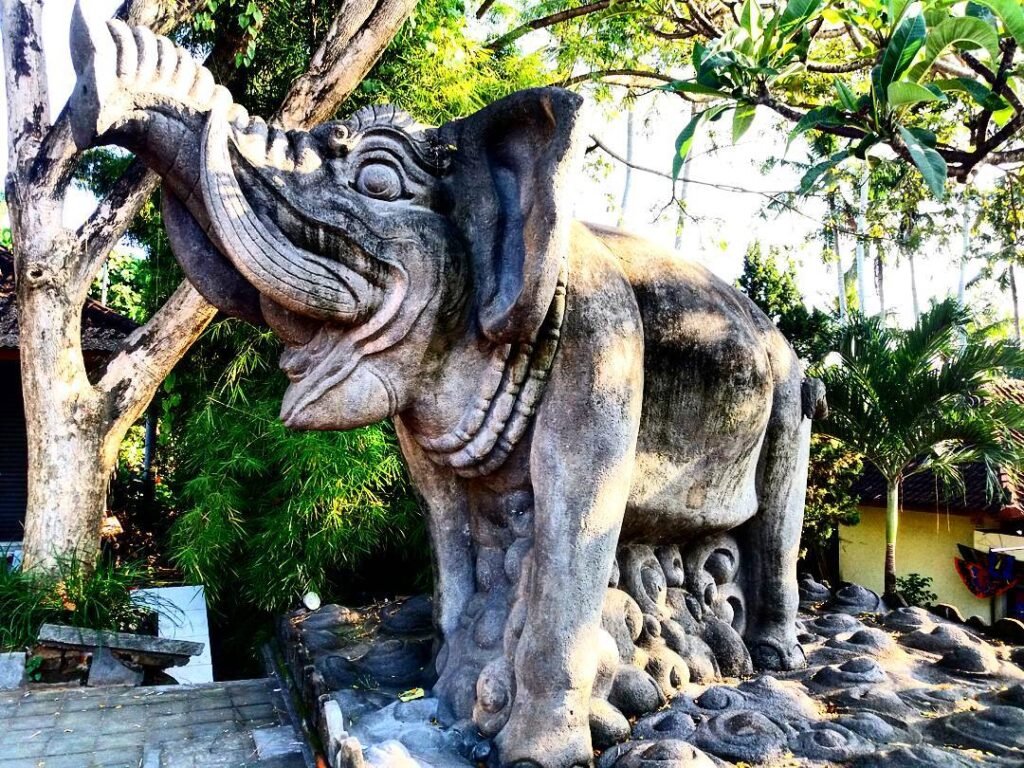
It is important to note that there have never been elephants in Bali. These animals appeared on the island only in the 1990s, when they were brought from Sumatra.
Significance of the cave
Goa Gajah symbolizes the synthesis of Buddhism and Hinduism as well as the ancient history of Bali. The site continues to attract tourists and researchers thanks to its mysteries, myths, and cultural significance. Even centuries later, it remains one of the island’s most mystical and awe-inspiring places.
Goa Gajah is located here