


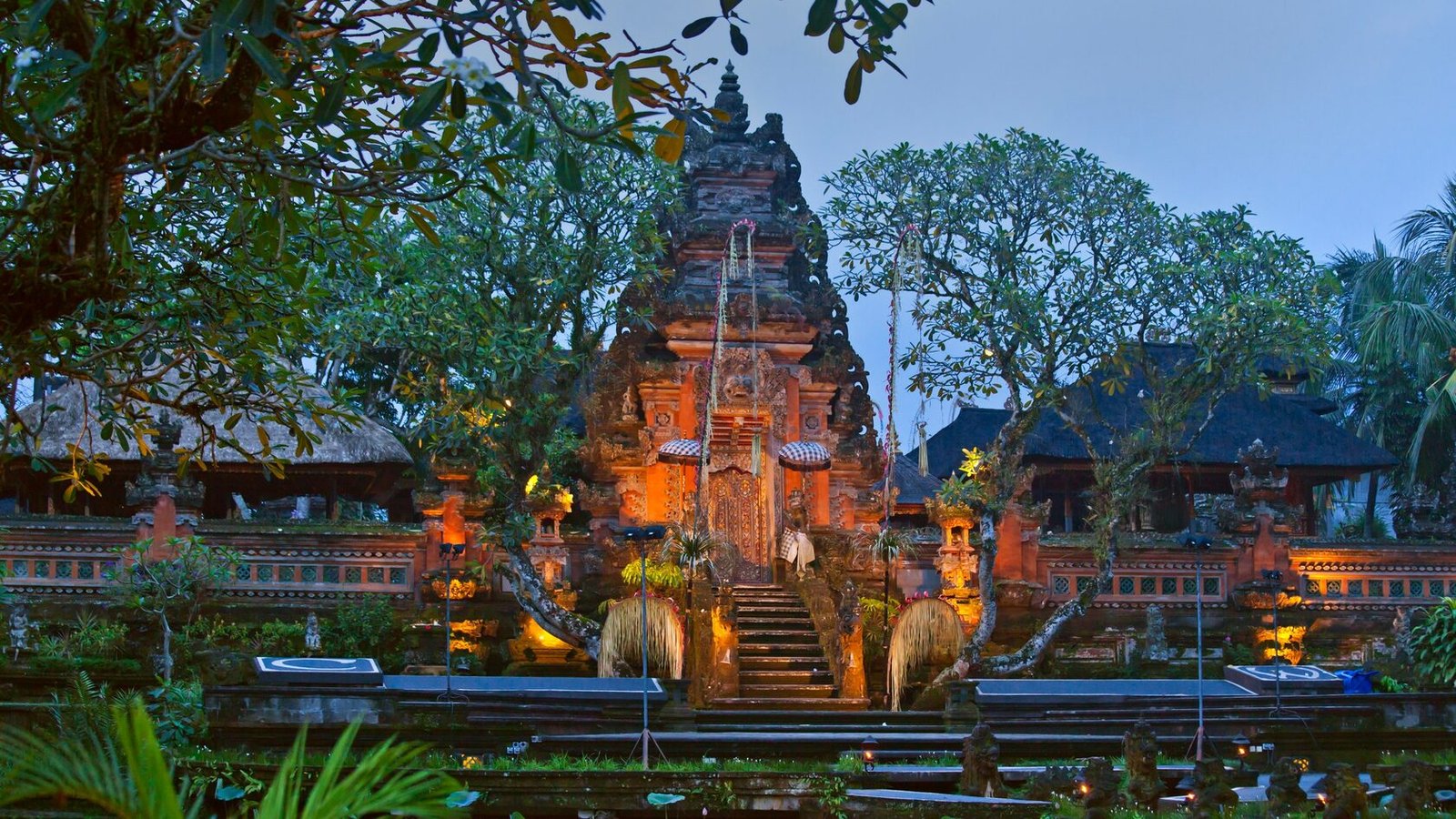
Pura Taman Saraswati temple is located in the very center of Ubud, within the grounds of the royal palace. Built in the mid-20th century, it is dedicated to the goddess Saraswati – the patroness of wisdom, knowledge, art, and creativity. This place is considered not only a religious site but also a cultural center, renowned for its unique architecture and beauty.
Saraswati temple: Three mandalas
Outer mandala (Nista)
Upon entering the temple, you arrive in the outer courtyard, which begins with a picturesque lotus pond. Lotuses, symbols of purity and spiritual enlightenment, bloom with large pink flowers that create a magical atmosphere. Around the pond grow frangipani trees, adding an exotic touch to the setting. A pathway across the pond leads to a circular platform decorated with a lotus flower installation. Here, you can see three stone-carved statues of deities.
Middle mandala (Madya)
Climbing the steps guarded by demons, you reach the kori agung gates. These triangular gates symbolize Bali’s sacred mountain and are decorated with carvings of flowers, plants, and mythical beings. At the center stands a magnificent golden door flanked by naga serpent figures.
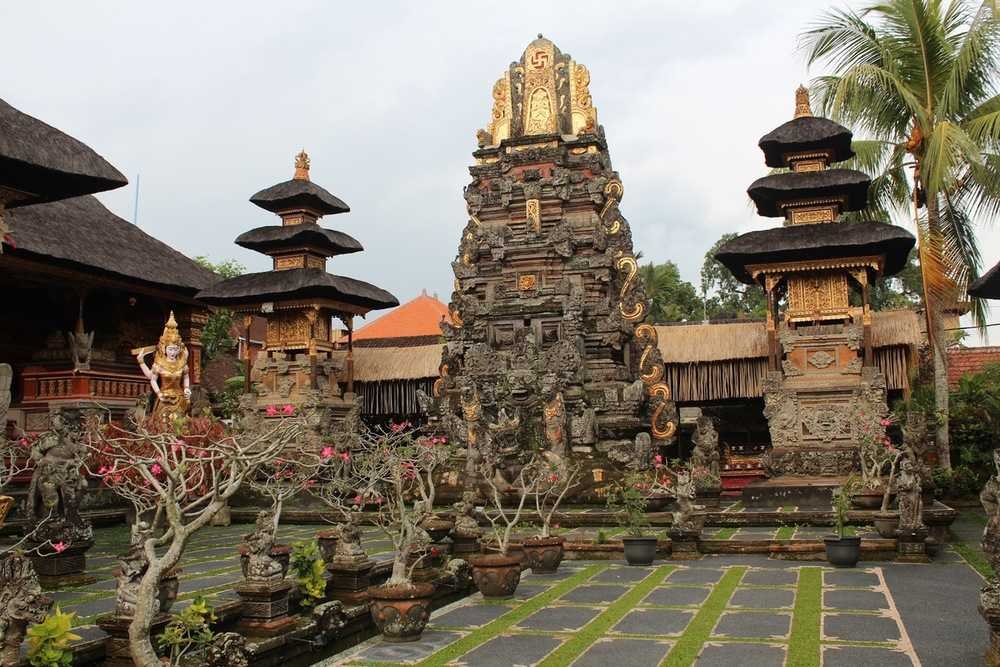
In the middle section of the temple are several pavilions. One contains three thrones for the Trimurti gods – Shiva, Vishnu, and Brahma. Here also stands a tall meru tower, while another pavilion serves as storage for Barong costumes – the lion and the boar, figures from Balinese mythology.
Inner mandala (Utama)
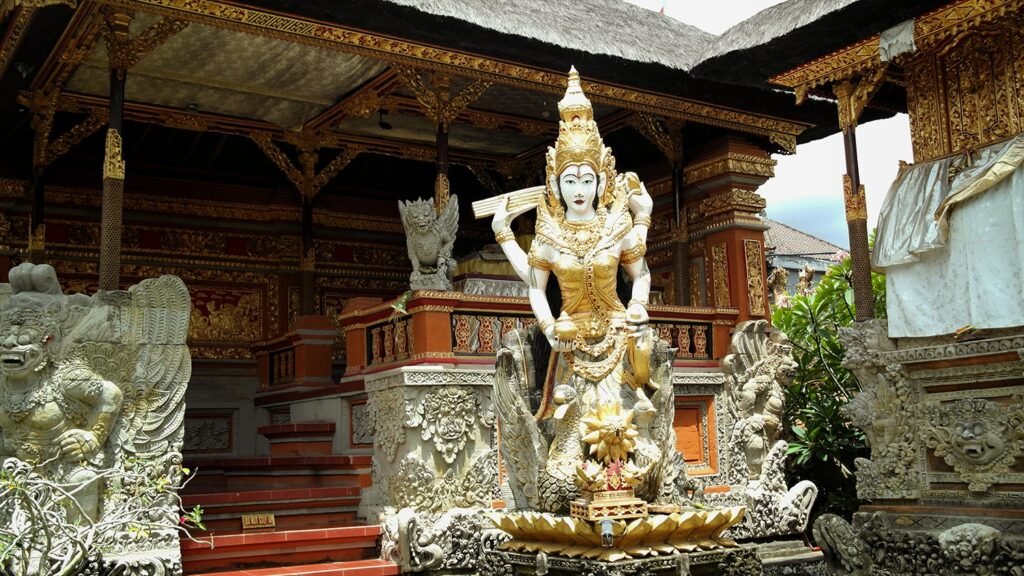
The inner courtyard houses the temple’s main shrines. The central figure is the statue of the goddess Saraswati, depicted with four arms symbolizing wisdom, creativity, and spirituality. Also located here is the Padmasana throne, dedicated to Sang Hyang Widhi Wasa, the supreme deity of Balinese Hinduism. The throne is adorned with carvings, gilded elements, and the sun symbol – the swastika.
This level also features a three-meter-tall statue of the demon Jero Gede Mecaling, representing protection from evil. However, access to the inner courtyard is open to tourists only during religious festivals such as Galungan and Kuningan.
Leisure and entertainment
Near the temple, there are cafés where visitors can relax and admire the lotus ponds and temple gates. Among them are Lotus Café and Starbucks, both with open terraces offering splendid views of the temple structures.
Every evening, except Friday, traditional dance performances take place here. Dances such as Kecak, Legong, and Barong showcase the remarkable artistry of Ubud’s performers, making the show a perfect conclusion to a visit to Saraswati temple.
The temple was built in 1951–1952, designed by the renowned architect and sculptor I Gusti Nyoman Lempad. This master initially worked at the royal court of Blahbatuh in Gianyar Regency. However, a conflict with the local ruler forced him to leave the town. Later, he was employed by the royal family of Sukawati in Ubud. Commissioned by them, Lempad built the Saraswati temple and reconstructed several buildings in the town.
Lempad was also a talented sculptor. Many of the stone figures in the temple were created by his hands. He became especially known for his grotesque depictions of gods and demons. Today, his works are preserved in Ubud’s museums.
Main deities of the temple
Saraswati
The temple is dedicated to Saraswati, the goddess of wisdom and creativity. Her name is interpreted in different ways: “mistress of the river” or “mistress of language.” In the ancient Vedas, Saraswati was regarded as the patroness of the river of the same name, whose exact location remains a subject of debate.
Her origins are described differently: according to one version, she is the daughter of Shiva and Durga, while another says she emerged when Brahma’s body was divided. She is considered the “mother of the Vedas” and the “mistress of music and speech.” In Bali, Saraswati is associated with wisdom that helps control emotions and thoughts, turning a person into the master of their destiny.
Sang Hyang Widhi Wasa
Sang Hyang Widhi Wasa is the supreme deity of Balinese Hinduism, symbolizing the One God. He is often depicted in a lotus posture, representing enlightened consciousness, and placed on top of the lotus throne – the Padmasana. In Bali, it is believed that all gods are manifestations of this single supreme deity.
The idea of worshiping one God became prominent after the establishment of the Republic of Indonesia, where only monotheism is officially recognized. This concept helped Balinese Hinduism preserve its place within the country’s religious system.
Jero Gede Mecaling
The demon Jero Gede Mecaling is a figure from Balinese folklore. He is believed to have been an exiled sorcerer who settled on the island of Nusa Penida. According to legend, he is responsible for epidemics, disasters, and mysterious deaths. To protect themselves from the demon, locals build altars on beaches, make offerings, and wear protective threads symbolizing the Trimurti – Brahma, Vishnu, and Shiva.
Jero Gede Mecaling is an exclusively Balinese character, unrelated to Hinduism. He reflects the fears of the local people toward unexplained events and illnesses. Many still avoid Nusa Penida, believing it to be the dwelling place of demons.
Significance of the temple
The Saraswati temple combines deep religious symbolism, architectural mastery, and cultural heritage. It serves not only as a place of prayer and rituals but also as a living embodiment of the legends and myths that make it unique among Bali’s sacred sites.
The Saraswati Temple is located here.